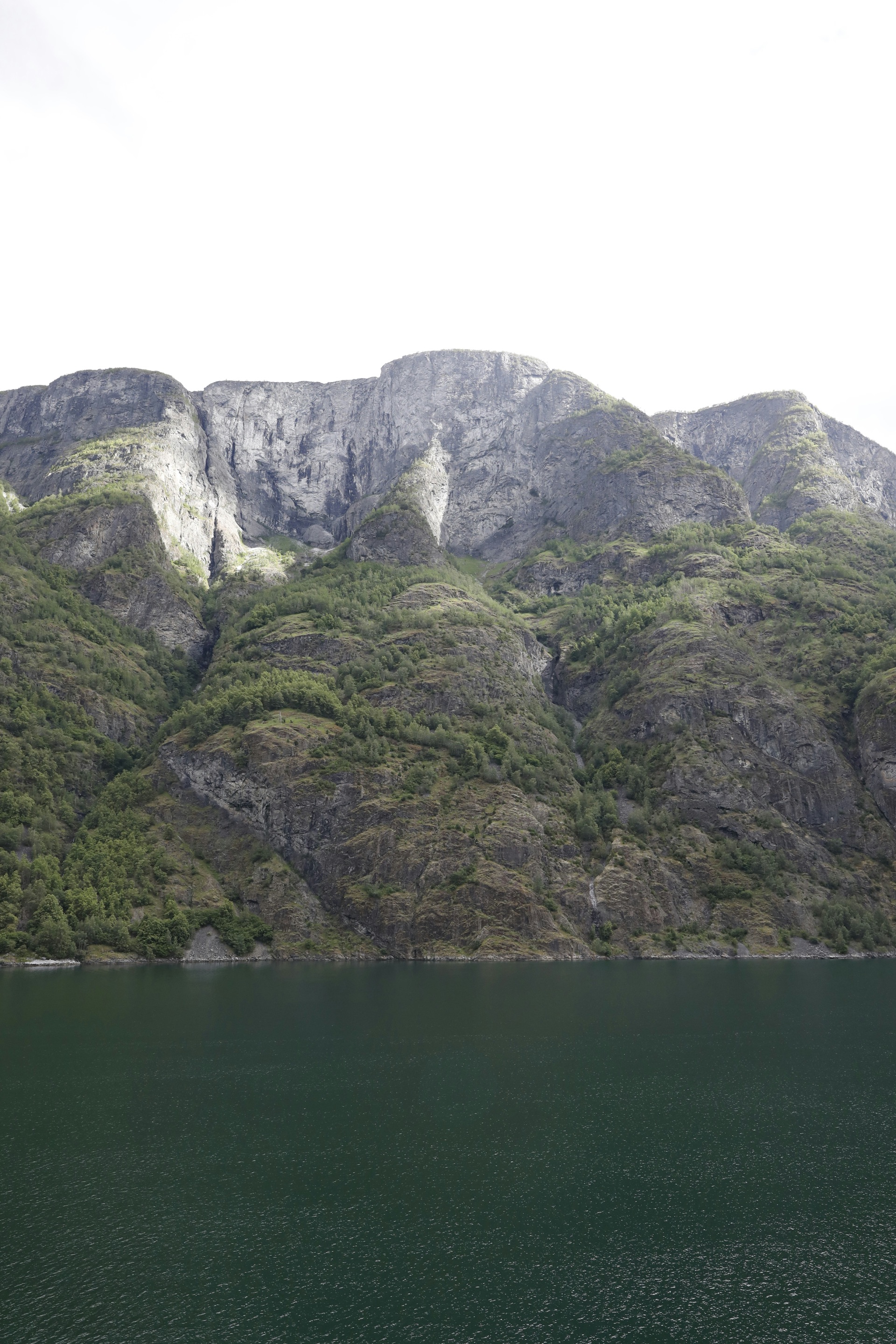
The term "midnight sun" gets applied loosely to all of Norway in summer, which sets expectations that the western fjords cannot technically meet. The Sognefjord sits at around 61°N — the Arctic Circle is at 66.5°N — so the sun does set here in June and July. What happens instead is this: it sets at around 11pm, the sky stays bright for another hour, and by the time any real darkness arrives it is past midnight and the sun is already on its way back up. For hiking purposes, the distinction barely matters.
What the evenings actually look like
At midsummer, Høyanger gets around 19 hours of daylight. The sun rises before 4am and does not set until nearly 11pm. On routes above 600 m, you are often above the shadow line well into the evening, watching the light change across the fjord for hours after the valley below has gone quiet.
What makes this different from just "a long day" is the angle. In mid-June, the sun spends the final two to three hours of its arc moving almost horizontally across the sky rather than dropping steeply. That means golden hour — the warm, low, directional light that photographers chase — lasts not twenty minutes but closer to two hours. The fjord turns amber. The mountains on the opposite shore go dark against an orange sky. The water below reflects everything.
It does not look like a photograph. Or rather, it looks exactly like a photograph, which is disorienting the first time you see it.
What it is like to hike in it
Starting a hike at 6 or 7pm in late June feels counterintuitive if you are used to Nordic latitudes reading as "dark and cold." It is neither. June evenings in the Sognefjord are often the calmest and clearest part of the day — the morning mist has long burned off, the midday haze is gone, and the light has a quality that flat midday sun never produces.
The trails above Høyanger empty out in the evening. Whatever foot traffic exists on the lower sections of routes like Fossestien and Bergefjellet during the day is gone by 7pm. You have the mountain largely to yourself. There is a quality of stillness on the upper sections in the evening that is different from a midday hike — less wind, different sounds, the fjord below turning from blue to gold as you climb.
Temperature drops as you gain elevation, which is worth accounting for. A summit at 960 m that feels warm at noon can be 8–10°C cooler by 9pm even in July. An extra layer in your pack is sensible. A head torch is worth carrying even in June, not because you will need it before midnight, but because conditions can change and having it means you do not have to rush back before an arbitrary time.
The routes that work best for evening hiking
Bergefjellet is the standout choice. The 960 m summit has a 270-degree view across the Sognefjord, and in the evening the light catches the water in a way that is simply not available at any other time of day. The route takes 4–5 hours return from the trailhead; start at 5 or 6pm in June and you will reach the summit in the heart of the golden hour window.
Fossestien works well as an evening walk rather than a full hike. The waterfalls catch the low light differently than at midday — the water appears almost luminous against the darker rock. It is 8 km return and accessible to all abilities, which makes it a good option if your group includes people who are not committed to a full mountain day.
The upper section of Kraftruta, for experienced hikers, offers some of the most dramatic evening ridge walking in the area. Above the treeline at 800–900 m with the full fjord system spread below you in evening light is one of those experiences that is genuinely difficult to describe without sounding like you are exaggerating.
Is it actually worth it?
The honest answer is: an evening hike in the Sognefjord in June is a different experience from the same hike at noon. Not better in every respect — midday has its own quality, particularly for visibility and warmth — but different in ways that most visitors do not expect and do not forget. The light alone justifies planning a trip around it.
If you are visiting the Sognefjord in June or July and you hike only during the day, you are missing the hours when the landscape is at its most photogenic and its most peaceful. That is not an opinion — it is just the geometry of the sun at this latitude in summer.
The Golden Hour Hike — timed for the evening light
A 2–3 hour private guided evening hike above Høyanger, departing in the early evening to reach the best viewpoints during the golden hour window. From NOK 1,950 per person.
See the Golden Hour HikeFrequently asked questions
Does western Norway have midnight sun?
Not technically. Midnight sun — where the sun stays above the horizon at midnight — only occurs above the Arctic Circle (66.5°N). The Sognefjord sits at around 61°N. What you do get in June and July is around 19 hours of daylight, shallow sun angles that produce golden light for two hours or more, and civil twilight so brief that it never gets truly dark. In practice, the experience of hiking at 9 or 10pm here is extraordinary, even if the sun technically sets before midnight.
What time does it get dark in the Sognefjord in summer?
Around the summer solstice, sunset at Høyanger is around 11pm, with civil twilight extending another 30–40 minutes after that. In late June and July you have usable daylight from around 4am to nearly midnight. By August, evenings start shortening noticeably — sunset moves to around 9:30pm by mid-August.
Is it safe to hike in the evening in Norway?
In June and July, evening hiking on well-marked routes is entirely safe — there is more than enough light until very late. A head torch is always worth carrying as a precaution. Evening temperatures drop as you gain elevation, so an extra layer is sensible even on warm days. On unfamiliar terrain, a local guide is the most reliable way to manage both route-finding and changing conditions.
Which is the best hiking route for evening light on the Sognefjord?
Bergefjellet offers the best combination of accessible summit elevation (960 m) and open fjord panorama for catching evening light. The Golden Hour Hike experience from Sognefjorden Hiking Tours is specifically designed around the evening light window — a 2–3 hour private guided route timed to reach the best viewpoints during golden hour.
When is the best month for long evenings in western Norway?
June is the best month — the days are longest, the waterfalls are still running strong from snowmelt, and the light at 9–10pm has a quality that is hard to describe until you have seen it. July is a close second. From mid-August onwards, evenings shorten quickly and the character of the light changes significantly.